IZON Q5013 Scientific Qnano Nanoparticle Analysis Particle Analyzer
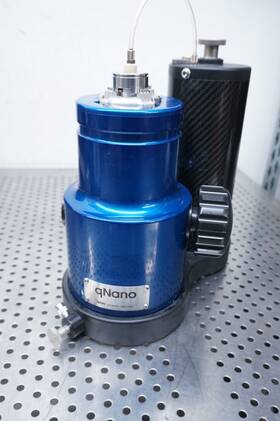
( Brand: Izon ), ( Manufacturer Part Number: Q5013 ), ( Part Type: Analyzer ), ( Unit Type: Unit )
Review IZON Scientific Qnano Nanoparticle Analysis Model Particle Analyzer
The **IZON q5013 Scientific qNano Nanoparticle Analysis Particle Analyzer** represents a cutting-edge advancement in nanoparticle characterization, designed to deliver unparalleled precision and versatility for researchers, scientists, and quality control professionals in fields such as pharmaceuticals, materials science, environmental monitoring, and nanotechnology. At its core, this instrument employs **single-particle optical sensing (SPOS) technology**, leveraging the principles of tunable resistive pulse sensing (TRPS) to measure nanoparticles with exceptional accuracy across a broad size range from sub-10 nanometers up to several hundred nanometers without the need for labeling or complex sample preparation. The qNano platform integrates a **fully automated, closed-loop fluidic system** that ensures minimal sample contamination and consistent performance, making it ideal for high-throughput applications where reproducibility is critical. Its **electroformed nanopore technology** allows for the precise sizing of particles based on their resistance changes as they pass through a single, nanometer-scale aperture, providing real-time data on particle size distribution, concentration, and zeta potential (when paired with optional modules). The analyzer s **user-friendly software interface**, qNano Control and Analysis Software, offers intuitive tools for data acquisition, analysis, and visualization, including advanced algorithms for particle classification, aggregation detection, and statistical reporting. With its **modular design**, the q5013 can be easily configured with additional sensors or accessories, such as the **qNano Zeta Potential Module** or **qNano Sample Dilution System**, to expand its analytical capabilities. This instrument excels in applications requiring **high-resolution nanoparticle characterization**, such as drug delivery system optimization, vaccine development, colloidal stability studies, and environmental toxin analysis, while its **low sample volume requirements** (as little as 10 microliters) make it highly efficient for precious or limited samples. Built with **robust engineering and compliance with strict industry standards**, including ISO and GLP guidelines, the q5013 ensures reliable, traceable results for both research and regulatory environments. Whether used in academic laboratories, pharmaceutical R&D facilities, or industrial quality assurance departments, the IZON q5013 stands as a cornerstone tool for advancing nanoparticle science with speed, accuracy, and adaptability.
### **Pros and Cons of buying a Izon qnano Particle Analyzer (Model Q5013)**
#### **Pros**
1. **High Precision and Sensitivity** The qnano series is known for its ability to detect and size nanoparticles with high accuracy, down to sub-10 nm range, making it suitable for advanced research and quality control in industries like pharmaceuticals, biotechnology, and materials science.
2. **Non-Destructive Analysis** Unlike techniques such as electron microscopy, the qnano uses tunable resistive pulse sensing (TRPS), which allows for real-time, label-free analysis without altering the sample, preserving nanoparticle integrity for further use.
3. **Wide Dynamic Range** The instrument can measure particles across a broad size spectrum (from 35 nm to 250 nm, depending on the nanopore used), reducing the need for multiple instruments or dilution steps.
4. **Fast and Automated Operation** The qnano is designed for high-throughput analysis with minimal user intervention, reducing sample preparation time and improving workflow efficiency.
5. **Compatibility with Complex Samples** It can analyze particles in various media, including buffers, biological fluids, and even some colloidal suspensions, making it versatile for different applications.
6. **Software Integration** The accompanying software (e.g., qNano software) provides detailed size distribution, concentration, and zeta potential (with optional modules) data, facilitating comprehensive particle characterization.
7. **Regulatory Compliance** The qnano is often used in industries where strict quality control is required, such as pharmaceuticals (e.g., for drug delivery systems) and nanomedicine, due to its reproducibility and validation capabilities.
8. **Modular Design** Additional modules (e.g., zeta potential, conductivity, or temperature control) can be added later, extending the instrument s functionality without a complete replacement.
---
#### **Cons**
1. **High Initial Cost** The qnano is an expensive investment, especially for small labs or startups. The base model and optional accessories can push the total cost into the tens of thousands of dollars, depending on configuration.
2. **Maintenance and Consumables** The instrument requires regular calibration, nanopore replacement (which can be costly), and maintenance, adding to long-term operational expenses.
3. **Sample Preparation Complexity** While the qnano reduces some preparation steps, certain samples (e.g., highly concentrated or aggregated particles) may still require dilution or filtration, which can introduce variability or loss of material.
4. **Limited Size Range for Small Particles** The smallest detectable particle size ( 35 nm) may not be sufficient for some applications requiring sub-10 nm resolution, necessitating complementary techniques (e.g., dynamic light scattering or TEM).
5. **Learning Curve** Proper operation and data interpretation require training, especially for users unfamiliar with resistive pulse sensing or nanoparticle analysis. Poor handling can lead to inaccurate results.
6. **Sample Volume Requirements** Some analyses may require relatively larger sample volumes compared to other methods (e.g., single-particle ICP-MS), which could be a limitation for precious or limited samples.
7. **Software Dependency** The effectiveness of the instrument relies heavily on the accompanying software. Bugs, updates, or compatibility issues could disrupt workflows if not managed properly.
8. **Not Ideal for All Industries** While excellent for research and quality control, the qnano may be overkill for basic particle sizing in industries where simpler, lower-cost methods (e.g., laser diffraction) suffice.
---
### **Ending Conclusion**
The **Izon qnano Q5013** is a powerful and versatile nanoparticle analyzer that excels in precision, non-destructive analysis, and high-throughput capabilities. It is particularly valuable for researchers and industries requiring detailed particle characterization, such as pharmaceutical development, nanomedicine, and materials science. However, its high cost, maintenance requirements, and complexity make it less suitable for budget-conscious or low-volume applications.
### **Recommendation**
**Purchase the qnano Q5013 if:**- You require high-precision, label-free nanoparticle analysis with a wide dynamic range.
- Your work involves pharmaceuticals, biotechnology, or advanced materials where particle size and distribution are critical.
- You have the budget and infrastructure to support the instrument s maintenance and consumables.
- You need a modular, future-proof solution that can be expanded with additional modules.
**Avoid purchasing the qnano Q5013 if:**- Your application only requires basic particle sizing and a lower-cost instrument (e.g., DLS or laser diffraction) would suffice.
- You lack the expertise or resources to properly maintain and operate the instrument.
- Your sample types are predominantly outside the qnano s optimal size range (e.g., consistently sub-35 nm or highly aggregated particles).
- You are working in a resource-limited environment where the upfront and operational costs are prohibitive.
**Alternative Considerations:**- For **budget-friendly options**, explore dynamic light scattering (DLS) instruments or field-flow fractionation (FFF) systems.
- For **sub-10 nm resolution**, pair the qnano with complementary techniques like transmission electron microscopy (TEM) or single-particle ICP-MS.
- If **zeta potential** is a key requirement, ensure the qnano is configured with the appropriate module or consider a dedicated zeta potential analyzer.
Ultimately, the qnano Q5013 is a premium choice for advanced nanoparticle research but should be carefully evaluated against project needs and financial constraints.
Details:
part #: q5013 prices
- $700.00-$3040.00
specifications pressureswitchiz:
- brand: Izon
- mpn: Q5013
- part type: Analyzer
- unit type: Unit
seller pressureswitchiz:
- rating: 99.7%
- # reviews: 6161
- city: Downey, California
shipping pressureswitchiz:
- carrier: UPS
- type: Fixed
- cost: $0.00
- transit: 3-7 Days
- class: Standard
- service: UPS Ground, Standard
returns pressureswitchiz:
- time: 30 Days
- policy: Returns Accepted
- paid by: Buyer
- method: Money back
general pressureswitchiz:
- Business Industrial > Hydraulics, Pneumatics, Pumps Plumbing > Air Pressure Gauges
- condition: Used
payments pressureswitchiz:
- credit card: Discover
- other
- wallet: Apple-pay
offer pressureswitchiz:
- best offers: True
- sold: 0
- options: Ship-to-home
- availability: In Stock
- quantity: 1
- started: February 23, 2026