ASK MITSUBISHI OPG-DU-R1-4-39-250 Glycerin Filled Pressure OPG-DU-R1/4-39-250
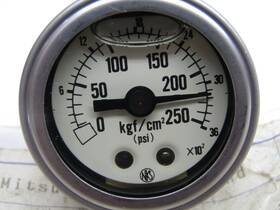
( Brand: Ask Mitsubishi ), ( Manufacturer Part Number: OPG-DU-R1/4-39-250 ), ( Part Type: Pressure ), ( Country Of Origin: Japan )
Review ASK MITSUBISHI Opg-du-r1/4-39-250 Glycerin Filled Pressure Guage
The **Mitsubishi OPG-DU-R1/4-39-250 Glycerin-Filled Pressure Gauge** is a high-precision, durable instrument designed for reliable monitoring of fluid pressure in industrial, automotive, and laboratory applications where accuracy and longevity are paramount. Engineered with Mitsubishi s reputation for quality and innovation, this gauge features a robust **1/4-inch NPT (National Pipe Thread) male connection**, ensuring secure and leak-proof installation in systems where space is limited but performance demands are high. The **glycerin-filled housing** provides superior protection against temperature fluctuations, corrosion, and mechanical shock, making it ideal for environments where traditional oil-filled gauges might fail under extreme conditions. With a **39-inch (990 mm) dial face**, this gauge offers ample visibility for readings, while the **250 psi (17.2 bar) maximum range** delivers precise measurements for applications requiring moderate to high-pressure monitoring, such as hydraulic systems, automotive brake testing, pneumatic equipment, and laboratory setups.
The gauge s **durable brass casing** and **stainless steel bourdon tube** ensure resistance to wear and tear, extending its operational lifespan even in demanding conditions. The **black enamel dial** is clearly marked with bold, easy-to-read graduations, allowing operators to quickly assess pressure levels with minimal ambiguity. Additionally, the **back-mounted connection** simplifies installation and maintenance, reducing downtime while ensuring a clean, unobstructed front panel for optimal visibility. Whether integrated into a hydraulic press, a test bench for automotive components, or a scientific apparatus requiring consistent pressure control, this gauge delivers the reliability and precision engineers and technicians depend on. Its compact yet sturdy design makes it a versatile choice for both new installations and retrofitting existing systems where space efficiency and performance are critical.
The **Mitsubishi OPG-DU-R1/4-39-250** is a glycerin-filled pressure gauge designed for use with hydraulic, pneumatic, or general industrial systems. Below is a detailed breakdown of its pros and cons, followed by a conclusion and recommendation.
---
### **Pros**
1. **Glycerin-Filled Design**
- The glycerin filling provides damping, reducing gauge oscillation and vibration errors. This makes readings more stable and accurate in dynamic systems (e.g., hydraulic presses, compressors, or fluctuating pressure environments).
- Glycerin is less volatile than mercury or oil, reducing the risk of leakage or contamination in the system.
2. **High Accuracy and Reliability**
- Mitsubishi is a reputable brand known for precision-engineered instruments. This gauge is likely calibrated to meet industry standards (e.g., ISO 2281, ANSI B40.100), ensuring consistent performance.
- The 1/4-inch NPT connection is standard for many industrial applications, making installation straightforward.
3. **Wide Pressure Range**
- The gauge measures up to **250 psi (17.2 bar)**, which is suitable for moderate to high-pressure systems (e.g., HVAC, automotive, or light industrial machinery). The 39-inch dial size provides clear visibility of pressure levels.
4. **Durable Construction**
- The metal housing and robust sealing are designed to withstand harsh environments, including temperature fluctuations and minor shock. Glycerin-filled gauges are generally more durable than dry gauges in cyclic or pulsating pressure applications.
5. **Compatibility with Various Fluids**
- Glycerin filling is non-corrosive to most metals and doesn t react with common hydraulic fluids (e.g., mineral oil, water-glycol mixtures), making it versatile for different systems.
6. **Easy Maintenance**
- Glycerin-filled gauges typically require less frequent recalibration than dry gauges in vibrating environments. The filling also helps protect the internal mechanism from dust and moisture.
7. **Cost-Effective for Industrial Use**
- While not the cheapest option, its longevity and accuracy often justify the investment in applications where gauge reliability is critical.
---
### **Cons**
1. **Limited Pressure Range**
- At **250 psi**, this gauge is not suitable for high-pressure systems (e.g., heavy machinery, automotive brake systems, or compressed air above 300 psi). For such applications, a higher-range gauge (e.g., 600 psi or 1000 psi) would be necessary.
- The **1/4-inch NPT connection** may be too small for high-flow systems, risking clogging or pressure drop.
2. **Potential for Glycerin Leakage**
- Over time, the glycerin filling can degrade or leak, especially if the gauge is subjected to extreme temperatures or mechanical stress. Leakage can lead to inaccurate readings or internal damage.
- Unlike oil-filled gauges, glycerin is more viscous and may not self-seal as effectively if the gauge is damaged.
3. **Size and Installation Constraints**
- The **39-inch dial** is large and may not fit in space-constrained applications. While this provides better readability, it can be impractical for compact systems.
- The **1/4-inch NPT thread** is standard but may require adapters for certain systems. Over-tightening during installation can damage the gauge or connection.
4. **Calibration Requirements**
- Like all pressure gauges, this model will eventually require recalibration to maintain accuracy. Industrial environments with frequent pressure fluctuations may necessitate more frequent checks.
- Calibration costs should be factored into long-term ownership.
5. **Limited Temperature Range**
- While glycerin-filled gauges perform well in moderate temperatures, extreme cold or heat (e.g., above 120 F/50 C or below freezing) can affect glycerin viscosity and gauge performance. For extreme conditions, a specialized gauge (e.g., oil-filled or temperature-compensated) may be needed.
6. **Higher Cost Than Basic Gauges**
- Compared to simple dry gauges or oil-filled models, this glycerin-filled gauge is more expensive upfront. The added cost may not be justified for low-pressure or static applications where damping isn t critical.
7. **Potential for False Readings in Extreme Vibrations**
- While glycerin damping reduces oscillation, in **extreme vibration** (e.g., heavy machinery or seismic activity), the gauge may still exhibit some lag or error. For such cases, a **vibration-proof gauge** or remote sensing system may be preferable.
---
### **Conclusion**
The **Mitsubishi OPG-DU-R1/4-39-250 glycerin-filled pressure gauge** is a well-engineered instrument ideal for applications requiring **stable, accurate pressure readings in moderately dynamic or vibrating environments**. Its glycerin filling provides damping benefits that improve reliability in systems where pressure fluctuations occur (e.g., HVAC, light industrial hydraulics, or pneumatic systems). The gauge s durability, compatibility with various fluids, and Mitsubishi s reputation for quality make it a strong choice for general industrial use.
However, it is **not suitable** for high-pressure applications (above 250 psi), extreme temperature environments, or systems where space is severely limited. Additionally, users must account for potential long-term maintenance (e.g., glycerin leakage, calibration) and the higher initial cost compared to simpler gauges.
---
### **Recommendation**
**Buy this gauge if:**- You need a **reliable, damping-filled gauge** for a system with **moderate pressure (up to 250 psi)** and **some vibration or pulsation** (e.g., hydraulic presses, compressors, HVAC systems).
- Your application involves **hydraulic fluids, water-glycol mixtures, or clean air**, where glycerin compatibility is beneficial.
- You prioritize **accuracy and longevity** over cost and can accommodate the **39-inch dial size**.
- The **1/4-inch NPT connection** is compatible with your system, and you can ensure proper installation to avoid damage.
**Avoid this gauge if:**- Your system operates at **pressures above 250 psi** (consider a higher-range gauge, e.g., 600 psi or 1000 psi).
- You work in **extreme temperatures** (below freezing or above 120 F/50 C), where glycerin performance may degrade.
- Your application has **severe space constraints** or requires **frequent high-flow measurements** (a smaller or oil-filled gauge may be better).
- You are on a tight budget and can use a **dry or oil-filled gauge** for static or low-vibration systems.
**Alternatives to Consider:**- For **higher pressures**, opt for a **Mitsubishi OPG-DU-R1/4-600-250** or similar 600 psi gauge.
- For **extreme temperatures**, choose an **oil-filled gauge** (e.g., Mitsubishi OPG-DU-R1/4-39-250 with oil filling).
- For **compact installations**, look for a **smaller dial size** (e.g., 2.5-inch or 4-inch) with the same pressure range.
- For **high-vibration environments**, consider a **vibration-proof gauge** or a **remote sensing system** with a local indicator.
In summary, this gauge is a **solid choice for its intended use**, but its suitability depends on matching it to your specific system requirements. Always verify compatibility with your fluids, pressure range, and environmental conditions before purchasing.
Details:
Next day shipping available. ASK Mitsubishi OPG-DU-R1/4-39-250 Glycerin Filled Pressure Guage. New Old Stock. Un-used new condition.
part #: opgdur1439250 price
- $80.00
specifications pressureswitchiz:
- brand: Ask Mitsubishi
- mpn: Opg-du-r1/4-39-250
- part type: Pressure
- country of origin: Japan
returns pressureswitchiz:
- time: 30 Days
- paid by: Buyer
- policy: Returns Accepted
- method: Money back
offer pressureswitchiz:
- best offers: True
- started: June 1, 2026
- options: Ship-to-home
- sold: 0
- quantity: 1
- availability: In Stock
general pressureswitchiz:
- Business Industrial > Hydraulics, Pneumatics, Pumps Plumbing > Air Pressure Gauges
- condition: New
shipping pressureswitchiz:
- service: USPS Ground Advantage, USPS Priority Mail, FedEx 2Day One Rate Pak
- carrier: USPS, FedEx
- class: Standard, Expedited
- transit: 3-7 Days
- type: Calculated
- cost: $0.00
payments pressureswitchiz:
- credit card: Discover
- other
- wallet: Apple-pay
seller pressureswitchiz:
- rating: 100.0%
- # reviews: 11543
- city: Burlington, Kentucky
Ask Mitsubishi OPG-DU-R1-4-39-250 Is Similar To:
- Opg-dt-r1-4 Ask New Pressure Gauge Npt (51% similar) ...(October 22nd, 2018)
- Opg-dt-r1-4-39x10mpa-s Ask Pressure Gauge (53.3% similar) New Ask OPG-DT-R1 4-39X10MPA-S pressure gauge please see data labels in pictures for technical details. EB1J22-PR39031921-50...(April 2nd, 2021)
- Ask Opgatg1 460x7mk Opg-at-g1 4-60x7mk 2-1 2in 0-7 Mpa 1 4in Pressure Gauge (50.4% similar) Important shipping notes. Free shipping includes USPS first class or parcel select. Ask OPG-AT-G1/4-60X7MK 2-1/2IN 0-7 map 1/4IN pressure gauge. If they are used working items pulls. Need this urgent. Parcel select can take a week or more and is for none urgent items...(January 28th, 2025)
- Ask D18439 Pressure Gauge 0-6 Mpa (45.4% similar) Ask pressure gauge 0-6 map, model #: D18439, used, untested, show wear. Need a part asap. Ask D18439 pressure gauge 0-6 map...(April 11th, 2025)
- Ask D18498 Pressure Gauge 0-6 Mpa (43.3% similar) Ask pressure gauge 0-6 map, model #: D18498, used, untested, shows wear. Ask D18498 pressure gauge 0-6 map. Need a part asap...(April 11th, 2025)
- Ask R417511 New Opg-dt-g1 4 60x6mpa-b Stainless Steel Pressure Gauge 0-6mpa Warranty (44.6% similar) Location TBB4048. Fast and flexible shipping. No warranty on untested/parts listings. Fast shipped with ups. Why j j industrial supply. Ships fast with ups. Local pick-up is always an option. Handled with care quickly. 30 day hassle free warranty. The j j triple aim: great products, great price, ...(May 1st, 2025)