UNITED INSTRUMENT 20-400G02L Oil Filled Water Pressure Gauge
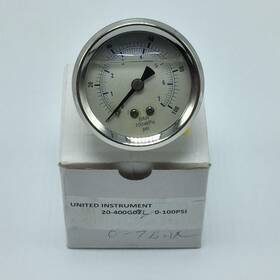
( Brand: United Instrument ), ( Manufacturer Part Number: 20-400G02L ), ( Part Type: Oil Pressure Instrument Gauge )
Review UNITED INSTRUMENT Pressure Gauge Oil Filled
The **United 20-400G02L Pressure Gauge** is a robust, oil-filled industrial-grade instrument designed to deliver precise and reliable pressure measurements in demanding applications where accuracy, durability, and long-term stability are critical. This gauge belongs to the **20-400 series**, a versatile line engineered for general-purpose use across a wide range of industries, including manufacturing, HVAC systems, automotive diagnostics, hydraulic testing, and pneumatic applications. The **oil-filled casing** ensures superior damping performance, eliminating erratic needle fluctuations and providing smooth, stable readings even under conditions of rapid pressure changes or vibration. This feature is particularly valuable in environments where sudden surges or pulsations could otherwise compromise measurement integrity, such as in compressed air systems, boiler operations, or hydraulic machinery.
Constructed with a **durable brass or stainless steel housing**, the gauge is built to withstand harsh operating conditions, including exposure to moisture, dust, and temperature fluctuations within its specified range. The **20-400 psi (1.4 to 27.6 bar) scale** offers a broad measurement range, accommodating both low-pressure and moderate-high-pressure applications with equal precision. The **front-mounted dial** features a **black enamel background** with **white Arabic numerals and tick marks**, ensuring high contrast for easy visibility even in low-light conditions. The **2-inch (50.8 mm) dial face** provides ample space for clear, legible readings, while the **back-mounted 1/4-inch NPT connection** allows for straightforward installation into piping systems, fittings, or equipment. The gauge is also equipped with a **screw-type mounting flange**, enabling secure attachment to panels or surfaces without the need for additional hardware.
One of the standout features of this pressure gauge is its **long-term accuracy and reliability**, thanks to the oil-filled mechanism that reduces friction and wear on internal components. This design minimizes the risk of gauge failure over time, making it a cost-effective solution for both short-term and extended use. The **bourdon tube**, a key pressure-sensing element, is precision-engineered to deliver consistent performance across the entire scale, ensuring that readings remain accurate even as the gauge ages. Additionally, the **sealed construction** protects against leaks, contamination, and corrosion, further extending the gauge s operational lifespan.
For applications requiring additional protection, the **20-400G02L** can be paired with optional accessories such as **glass tubes** for visual leak detection or **screw-type connections** for enhanced sealing. The gauge also adheres to **industry standards**, including those set by the **ANSI (American National Standards Institute)** and **ISO (International Organization for Standardization)**, ensuring compatibility with most pressure measurement protocols. Whether used in a workshop, industrial facility, or mobile diagnostic setting, this pressure gauge offers a perfect balance of **performance, durability, and ease of use**, making it an indispensable tool for professionals who demand dependable instrumentation.
**Pros and Cons of buying a United 20-400G02L Pressure Gauge (Oil-Filled)**
### **Pros**
1. **Durability and Longevity** Oil-filled pressure gauges are designed to withstand harsh conditions better than dry gauges. The oil cushion absorbs shock and vibration, reducing wear on the internal mechanisms, which extends the gauge s lifespan.
2. **Accurate Readings** The oil filling dampens fluctuations in pressure, providing smoother and more stable readings. This is particularly useful in applications where pressure varies rapidly, such as in HVAC systems, hydraulic equipment, or automotive diagnostics.
3. **Protection Against Temperature Fluctuations** Oil-filled gauges are less affected by extreme temperatures compared to dry gauges. The oil acts as a thermal buffer, reducing errors caused by thermal expansion or contraction of the internal components.
4. **Resistance to Vibration and Shock** In industrial or mobile applications (e.g., trucks, construction machinery), vibration can damage a dry gauge s delicate internal parts. The oil filling absorbs these impacts, making this gauge more reliable in dynamic environments.
5. **Wide Pressure Range** The 20-400 PSI range (or equivalent in other units) makes this gauge suitable for a variety of applications, from low-pressure systems (e.g., refrigeration) to moderate industrial processes.
6. **Easy Installation and Maintenance** Most oil-filled gauges are straightforward to install, requiring only basic tools. They typically do not require frequent calibration or adjustments, reducing downtime.
7. **Cost-Effective for Long-Term Use** While the initial cost may be slightly higher than a basic dry gauge, the durability and accuracy make it a cost-effective choice over time, especially in demanding applications.
8. **Compatibility with Various Fluids** Since the gauge itself is sealed with oil, it can be used with a wide range of fluids (water, air, oil, etc.) without risking contamination of the internal mechanism.
---
### **Cons**
1. **Higher Initial Cost** Oil-filled gauges are generally more expensive than standard dry gauges. The added manufacturing complexity (sealing, oil filling) contributes to this higher price.
2. **Limited High-Pressure Applications** While this gauge covers 20-400 PSI, it is not designed for extremely high-pressure systems (e.g., above 1,000 PSI). For such applications, specialized high-pressure gauges would be required.
3. **Potential for Oil Leakage Over Time** Although rare, the sealing around the gauge s filling port or dial can degrade over years of use, leading to oil leakage. This could affect accuracy or require replacement.
4. **Slightly Slower Response Time** The oil filling adds some inertia, which may cause a minor delay in pressure reading changes compared to dry gauges. This is usually negligible in most applications but could be a consideration in highly dynamic systems.
5. **Not Ideal for Extreme Low-Temperature Environments** While oil-filled gauges perform better than dry ones in temperature variations, very low temperatures (e.g., sub-freezing) can cause the oil to thicken, potentially affecting gauge performance.
6. **Limited Customization** Unlike some industrial gauges, this model may not offer extensive customization options (e.g., different mounting styles, additional ports, or specialized dial markings).
7. **Disposal Considerations** If the gauge needs to be replaced, the oil filling may require proper disposal, though this is rarely an issue for small quantities.
---
### **Conclusion**
The **United 20-400G02L oil-filled pressure gauge** is a robust and reliable choice for applications requiring accurate, stable pressure readings in environments with vibration, temperature fluctuations, or moderate pressure demands. Its durability and resistance to wear make it ideal for industrial, automotive, HVAC, and general mechanical systems. However, its higher cost and limited suitability for extreme high-pressure or low-temperature conditions may make it less ideal for specialized or high-end applications.
For most users seeking a balance between accuracy, longevity, and ease of use, this gauge is a **strong recommendation**, particularly if the application involves dynamic or harsh conditions. If budget is a primary concern and the environment is stable (low vibration, moderate temperatures), a dry gauge might suffice. However, the added protection and performance benefits of the oil-filled design often justify the investment for long-term reliability.
**Final Recommendation:**Purchase the **United 20-400G02L oil-filled pressure gauge** if you need a durable, accurate, and vibration-resistant gauge for general industrial, automotive, or HVAC use. Verify that the pressure range (20-400 PSI) matches your application and ensure proper installation to maximize its lifespan. For extreme conditions (e.g., very high pressure or sub-zero temperatures), consider a specialized gauge model.
Details:
New in Mfg Packaging; 2 Gauge, to 100 PSI / 0-7 Bar, 1/4 NPT Back, Gauge Filled With Glycerin.
part #: 20400g02l price
- $21.15
specifications pressureswitchiz:
- brand: United Instrument
- mpn: 20-400g02l
- part type: Oil Pressure Instrument Gauge
payments pressureswitchiz:
- credit card: Mastercard
- other
- wallet: Google-pay
offer pressureswitchiz:
- availability: In Stock
- started: February 25, 2026
- best offers: True
- quantity: 1
- options: Ship-to-home
- sold: 0
general pressureswitchiz:
- condition: New
- Business Industrial > Hydraulics, Pneumatics, Pumps Plumbing > Air Pressure Gauges
seller pressureswitchiz:
- city: Middletown, Ohio
- # reviews: 7348
- rating: 99.9%
shipping pressureswitchiz:
- transit: 2-6 Days
- type: Calculated
- class: Expedited, Standard, One-day
- service: USPS Priority Mail, UPS Ground, UPS Next Day Air
- carrier: USPS, UPS
- cost: $16.80
returns pressureswitchiz:
- time: 30 Days
- paid by: Buyer
- policy: Returns Accepted
- method: Money back
United Instrument 20-400G02L Is Similar To:
- 100xpa Duro-united Liquid Filled Bottom (30.1% similar) Douro-united liquid filled bottom mount gauge 1/4 not psi...(August 25th, 2017)
- 15-200nd United Instrument 2 Pressure (61.5% similar) 2 United Instrument pressure gauges 15-200NDNEW...(June 3rd, 2017)
- 2030012201806 United Instrument Gage Compound Dial Diameter To Hg Psi (45.5% similar) United Instrument Gage, compound, dial diameter 30 to 15 Hg psi. In contiguous 48 USA. This is new, old stock. Please see pictures for more detail...(June 2nd, 2018)
- Switch Valve Delta Controls United 24-013 Differential Pressure Pro Electric (38.5% similar) New stock in pkg. United electric controls delta pro pressure switch 1/1 0 paid...(January 25th, 2015)
- 3-30psi Electric United J54 Switch Pressure (35.1% similar) United electric J54 pressure switch 3/3 0PSI new J54 this item is brand new...(January 28th, 2015)
- 505-s United States Gauge Us Vac Press (43.5% similar) 30 vac press. Bottom MOUNT2. 5 face diameter...(January 19th, 2019)
- 505630v150p United States Us Gauge Vac Press (42.9% similar) 5 face diameter. 30 vac to 150 press. Range bottom MOUNT2...(January 19th, 2019)
- Ansi-b40.1 United Instruments Lot Of Pressure Gauge (62.9% similar) 005990870-01 module T25328 us now fluke trend b clock ram T13140 1,000. Industrial supplies industrial equipment fiber optic slab equipment restaurant equipment industrial automation controls test equipment retail services semiconductor PCB equip. Lot of 10 United Instruments ANSI-B40. 00METTLER ...(September 4th, 2018)
- Controls Pressure H105-s156b United Stainless Electric Steel 9645 Switch 316l (26% similar) United electric controls pressure switch cat H105 S156B 9645 316L stainless steel vac...(May 18th, 2015)
- 100psi Electric 480v-ac 125 Ue B213634 United H121-s156b Switch Pressure 250 15a (29.9% similar) For cancelled orders, a 35 service fee will apply. Our daily shipping cut off is 3/0 0PM eastern time...(March 31st, 2015)
- H400-552 Controls Electric Switch 5.5psi M201 M550 United Options Pressure (28.1% similar) 5PSI incur this is untested. Please refer to the pictures for more details. 1450 Lyell , NY 2460 ext. Item is in good physical condition as pictured. Only pictured items are included cables and other accessories are not included unless explicitly stated shown in pictures. Some minor wear and tear is...(July 6th, 2015)